Tag Archives: Travel Blogger

We hopped on a cruise…

We were “COVID-ed out” of a large portion of our African itinerary 18 months ago. Remarkably, Paige hooked us up with a three week stint on an Oceania world cruise (600 passengers) which got us most of what we had been denied in addition to some island countries and a surprise, ending in Dubai, a perfect gateway to Central Asia.

First stop – Mossel Bay, South Africa. According to Lonely Planet it’s the ugly sister of the Garden Route.

The Garden Route is on South Africa’s “must see” list for its natural beauty – from Mossel Bay to Port Elizabeth – offering lagoons, lakes, mountains, forests and beaches.

*** click on photos to enlarge

Since cruise excursions are not our style we ventured off on our own hoofing it uphill to Marsh Street – the main thoroughfare. Our mending calves still remind us of our downhill hike. We stopped for a brief time to listen to the Stations of the Cross being recited at the Anglican church then off to look for a lunch spot. Most places were closed because it was Good Friday. Thank goodness because the one restaurant that was open served the most delicious chicken and leek quiche.

Continuing on to the lighthouse we stumbled upon hundreds of campers in tarp covered tents and RVs smooshed in like sardines on Easter holiday. A treasure trove of ocean tide pools had children and adults scouring for a golden nugget.

Durban – South Africa’s third largest city and claims the largest concentration of Indians living outside of India.

Archaeologists have evidence that Durban has been inhabited by hunter gatherers since 100,000 BC.

We stuck to the beach area walking along the shore and the rambling promenade known as the Golden Mile that stretches for over two miles. It was lengthened leading up to the 2010 FIFA World Cup. Perhaps they should rename it the Golden Miles…

The faintest coastal haze painted the horizon but that didn’t stop the sun from beating down. It was the warmest temperature we’ve experienced since last October in Charleston. The breeze off the Indian Ocean made it tolerable.

Lifeguards cordon off areas to indicate safe swimming zones keeping people away from the strong riptides. Beyond the break a net protects the area from the great white shark population.

Our last stop was Richard’s Bay – the busiest port in South Africa. We have nothing interesting to report other than we bought toothpaste and toothbrushes!

Upon recommendation from a gentleman that we met in Lesotho I took time to read Invictus: Nelson Mandela and the Game That Made a Nation. A fabulous read!

We say goodbye to South Africa after three weeks.

And we’re off to Cape Town

We left Maseru, Lesotho around 7:30 pm. After a long drive out and back from the falls our driver wanted to stop by his home to grab some clothes and to drop off his 9 mm handgun (later disclosed).

Two hours later we arrived at our hotel in Bloemfontein, South Africa. Thank goodness the restaurant was still open.

JRR Tolkien, the author of the Hobbit and The Lord of the Rings was born here. However, he moved to England when he was three.

We didn’t have time to explore and we’re off to Beaufort West in the Karoo National Forest – the half point on our drive to Cape Town.

Long gone are the green mountains of Lesotho. It feels like we were transported back to our home state of Nevada – desert and brown. The only difference was the flat top mountains. Although it’s the end of March it’s more like October as they’re heading into winter.

The highway is free of potholes and we are on a mission to get to our next destination. After stops for bathroom breaks, approximately 7 hours later, we rolled into the quaint town of Beaufort West. Old Colonial buildings lined the main road.

This is home town to Christiaan Barnard who, in December 1967, performed the world’s first human heart to heart transplant. Imagine that. Such a feat of medical science in a tiny town in South Africa!

We stayed at the Savoy Hotel equipped with an American diner in its lobby.

Tonight we experienced the power load shedding that has blanketed the country. At 8:00 pm the power shut off. A safety light remained on in the bathroom but otherwise it was dark. So much for charging our devices. We’re pioneers – who needs power?

Power was off and on in the night and in when we left for our last leg of the trip.

It again was startling how similar the landscape was to home until we entered the wine country where vineyard blanketed the horizon. The best advertisement for thirsty travelers.

We said our goodbyes to Stephen in Cape Town, our guide for the past several days. He took good care of us and never lacked for a story to tell. I will give you his information if you decide to go to Lesotho.

*** Thank you for all your kind comments. I want you to know that I am receiving them and I respond to each one. It appears that you are not receiving the replies. I apologize and will see if there is a fix.

More Photos of Lesotho

Photos were taken through the window, out the window, me sitting in the window – legs in body out (the police had a grin when they drove by), through the sunroof and pulled over and out of the car.

Boys go through an initiation to become a man and they paint their animals and face as part of the process.
Oh, their hats…


We visited a yarn manufacturing store.  The owner teaches disabled people (all women but one man) how to make item yarn so that they have a skill.

Lesotho – The Kingdom in the Sky

Our new driver arrived as the sun started to kiss the morning with a stunning display of pink, yellow and baby blue. It was 6:00 am. The sweet receptionist made us a road trip bag with an egg, cheese and tomato sandwich, fruit drink and an apple.

Today we head to the country of Lesotho (sounds like Lay-sue-to) surrounded by South Africa. They too have a king but unlike Eswatini he is a hood ornament and the Prime Minister is the head of government. The country gained its full independence from British rule in 1966.

The first King Moshoeshoe from the early 1800’s had 144 wives! The cuenta king has one.

Lesotho has the highest mountains in Southern Africa and it’s lowest elevation of 4,593’ is the highest low point of any country in the world. Say what?

Normally I am very unsettled when riding on roads with steep drop-offs but having seen photos of the Sani Pass I was all about it! Bill was shocked!

Per Wikipedia: The route up Sani Pass starts at 1,544 metres (5,066 ft), and climbs 1,332 m (4,370 ft) to an altitude of 2,876 m (9,436 ft).

*click on photos to enlarge 

It requires a 4×4 as the road is unpaved, rocky and full of switchbacks. The South African border is near the bottom of the pass then a 5 mile drive through no-mans-land got us to the Lesotho border at the top. It took us an hour. The mountains look like velvet blanketed by the morning sun. Jaw dropping and stunning.

We were so lucky to have navigated the whole pass without coming in contact with another vehicle.

Top of the pass:

We passed a winter ski area and the beginnings of a large dam (a 3 Gorges scale) and literally hundreds of shepherds with their small flocks of cattle, Marino sheep or Angora goats.

We continued on another four plus hours to the Maliba Lodge in the Tsehlanyane National Park where we got to lounge for two nights. A welcome break from all the drive time.

View from our room.

A new driver and his apprentice picked us up in the morning and we headed out to explore the countryside. It’s incredible. The green undulating mountains are endless.

Rural life is tough. Homes are small and made of stone or cement mostly with no running water and power. They are lucky to own a donkey or horse for transportation otherwise they get around on foot or by taxi or small van busses.

This is not true of the whole country. Suburban areas have better access to utilities and perhaps 20% own cars.

Tiny buildings (shacks) have tall poles with colored plastic bags waving in the wind displaying what they have for sale that day. White means beer (locally made and super strong) and bread, green means vegetables and red means meat.

School children can walk upwards of two plus hours to get to school. Whizzing down the road is more frightening than the Sani Pass. We come within inches of school children, walkers or head boys (Shepards) with flocks of sheep or herds of cattle who all casually take up their fair share of the road space.

The mountains ooze water making them glisten like diamonds. Speaking of diamonds. Lesotho is a leading producer of diamonds in the world and sets a record for having the highest diamond mine in the world.

We took a small hike down to see the Kome Caves. Built in 1824. There are 6 separate single room caves in the side of the mountain insulated with mud and cow dung. We were told that the original families used these to hide from the cannibals. One descendent still lives in one of the caves. We met her on her way back from a long steep hike to buy paraffin wax so that she could heat her dinner. There is no power and water dripping off of the overhanging cliff is collected in a barrel. Lucky outdoor bathrooms were recently installed since this has become a tourist destination.

We stayed one night in the capital city of Maseru arriving in time for dinner where we were the only people at the hotel restaurant.

Workers leaving the city create bumper to bumper traffic lasting for hours. It was crazy watching the madness as the cars and walkers managed intersections. Chaos!

The road to Semonkong was like driving a rollercoaster with a slow click, click, click to reach the high peaks and the thrill of dropping and turning as we made our way to the Maletsunyane Falls. The 670 feet drop next to the falls has a spot in the Guinness World Record book for having the longest commercially operated single-drop rappel in the world.

Lesotho is not on the world’s tourism radar and they are taking baby steps to change that. It’s so low that can go through immigration at the border faster than getting a hamburger at McDonalds.

I highly recommend to anyone going to see South Africa that you take a few days to explore this magnificent country. The scenery is like no other.


The Kingdom of Eswatini

I ate some humble pie this morning as I face planted it in the hotel lobby. On the phone, and walking with my heavy pack on, I twisted my ankle (which I’m famous for doing ) and was unable to stop the slow motion fall. I heard the workers in the reception area gasp and then come running. There was no hiding.

Since we’ve never driven on the right hand side of the road we hired a driver to take us to Eswatini.  

It was a zigzaggy climb out of Johannesburg. Condos became homes – smaller than the ones upon entry but equally guarded by razor or electrical fencing.

The first stop was to get gas. Everyone left their cars running as the attendant pumped the gas. Fumes filled our lungs and I prayed we wouldn’t explode.

The hills became rich farmland with corn fields as far as the eye could see. It remained constant for a couple hours until we exited the N1 highway for a smaller 2 lane country road. Farmland gave way to man made eucalyptus and pine tree forests for miles on end. 

*click on photos to enlarge (many are life outside the car’s window)

Swaziland was renamed Eswatini (which t he locals have not embraced) in 2018 when the king celebrated the country’s 50th year of independence and his 50th birthday. We’re told he currently has 13 wives and 35 children. He rules the country with ultimate power unlike the British monarchy.

Our driver also told us that in Eswatini a man can not buy farm land (acreage) unless he has a wife. Marinate on that for awhile…

Mbabane is the condensed capital city which rests in the bottom of an old mine. Thankfully we stayed in Lobamba in the Ezulwini Valley where the area is dense with greenery reminiscent of Asia.  Per the hotel’s write up we were tucked beneath Sheba’s Breast Mountain. 

The central and most inhabited areas of Eswatini are surrounded by 360 degrees of mountains and farm land in the Valley.

The next day we toured the high points of Eswatini and visited a homestead where Bill helped Grandma get the chicken ready to become lunch. Fetching water for their home from the tap up the hill tested our strength after being sedentary for the past month.  I was encouraged to carry a pail full of water on my head which is customary.  I barely could lift it with my hands and could only imagine my neck bones crushing under the weight.  If only he had made the suggestion when it was empty!

Upon exiting the country and going back into South Africa the border guard, with a big smile on his face, asked if we smoked ganja. He was serious and then greatly disappointed when we said no. Although illegal in Swaziland it is known to grow the best marijuana in all the region.

It was until 2:00 pm that we started our 9 hour drive to Underberg, South Africa. The roads are riddled with potholes and make driving tenuous. We were in the car 14 hours – arriving in Underberg at 11:00 pm. Our next driver would pick us up in 7 hours…

First stop – Charlotte, NC

Twas a quick trip for snuggles with the grandbabies and catch up time with their parents.

If felt good to finally be out of the snowy cold.

The trees were showing off their stunning and willowy blossoms reminding us of the renewal of Spring. It’s just what the doctor ordered.

Funny little side note. I did all of our laundry yesterday but, of course, needed to wear an outfit to dinner. First bite of guacamole ended up down the front of my shirt and pants.

I rewashed them and threw them in the dryer with a forgotten tube of red lipstick in the front pocket of my pants.

Unremovable red blotches adorned my shirt and the dark jeans hid the red – for now.

Just imagine the inside of the dryer.

No long sleeves needed when our 15 hour flight lands in 80 degree weather at our next destination….

What’s in my bag

I’m often asked, “How do you pack for a four-month trip?”

Carefully!  It’s impossible to pack enough clothes to last 4 months.  

The only thing we check is our ego.  We never check our luggage. All of our possessions have to fit in a wheelie carry-on suitcase and a medium-sized backpack.

Remember the mix-and-match children’s clothing line Geranimals?  Created for kids!  An approach to which I subscribe.  Mix-and-match items where every top can be worn with every bottom create a more diverse wardrobe.

Temperatures on this adventure will range from the low-40s to the mid-90s.  I might look like a fool carrying around a down jacket when it’s 90 degrees but my coat also makes for my DIY down pillow.  I pop my jacket into my homemade pillowcase secured by Velcro at one end and voilà. My comfort item which I will use more than anything.

Shoes – what grief!  They take up so much space.  Fashion takes a backseat  (hence checking the ego) to what’s practical.  On this trip, I’m taking my Altra Running Shoes (stuffed with pills and electronic items), Dansko Beatrice clogs, and flip-flops.  I cringe.  

Inside my suitcase:

Inside my pack:

  • Black poncho – serves as a makeshift blanket as well
  • Lightweight Altheta Uptown Hooded Puffer down jacket (bought used on Poshmark) – the inners for my pillow
  • Super lightweight pullover windbreaker
  • Under Armor lightweight zipper-up jacket
  • Camera and gear
  • iPad and Kindle

I’ve been packed and ready to go for two weeks.

Then two weeks became three when we both got super sick and had to postpone our trip……


The Maasai of Tanzania

I teased Amon that I’d forgive him for not finding a rhinoceros (one of the big five) if I could stop somewhere to get a photo of a Maasai woman.

He did much better than that.  He took us to a Maasai village called an Enkang! I had to pay $20.00 for the experience (Bill sat this one out).  The money goes to buy drinkable water.

The Maasai people are a nilotic ethnic group that live in southern Kenya and northern Tanzania. This village sits about 6,000 feet, and as the photos show the rainy has not yet arrived. 

A finely beaded wide necklace was draped around my neck and a group of women and men serenaded and danced their welcome.  I was then encouraged to join the women as we bobbed our way into their fenced camp.

Two pairs of glasses and a camera around my neck trying to keep up:

Let the jumping competition begin.  The men and women separated, sang and competed in a jumping contest.

WOW!  The music. Dancing. Experiencing another culture. I’m grinning from ear to ear.

After the ceremony I was invited into a home to meet a young family.

Their cow dung homes are called bomas. I had to duck down low to enter and wind through the opening much like the opening of a snail shell.  The first small area is sectioned off for their calf. The sleeping area is a raised bed of dried mud with a cow hide scraped clean of its hair top.  It probably measures 3′ by 4′ feet. Next to that is a tiny area for a child. The raised beds also provide seating. In the middle a small fire on the floor.  The only light comes from a 6″ x 6″ hole in the ceiling above the fire.  There is no electricity and no running water.

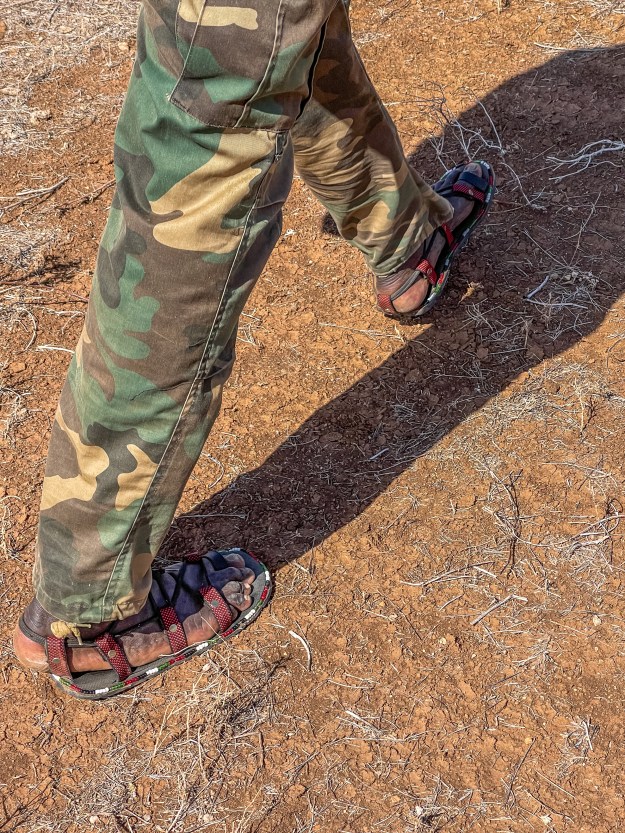
Sandals are made of motorcycle tires.

Children’s sleeping area.

120 people live in this completely fenced village called an Enkang.  The elder male in this Enkang is 92 years old, has 12 wives and 72 children.  The children go to seven years of government school and walk miles and miles to get there.  Young children were being schooled in another boma right outside the fenced area.  Nearby is another boma outside the fenced area where single men take turns guarding the Enkang.

I was able to watch the children doing their school lesson.  A young boy guided the classroom in saying numbers and the alphabet in English.  I then sat with them and taught the kids closest to me to fist bump with a finger explosion.

School house for little kids.

Look how the kids in the back have their hands in a fist or the explosion. Yes!

The men are herders.  They own cattle and goats. They are everywhere in the countryside grazing their herds. The women make beaded jewelry, placemats and animals to sell to tourists.  Their diet consist only of cow meat, goat meat and blood/milk from the same animals.  That is it!  No veggies, no fruit, no starch.

In researching the Maasai I learned that genital modification of both sexes initiate children into adulthood. Click on the Maasai in the previous sentence to read about their unique lifestyle.

The whole experience was fascinating. I could have done without the hard sell on the beaded items but I get it…..  (and got it- HA!).

What an experience.

Enkang’s in the countryside:

The Serengeti

Ah the Serengeti (Maasai – meaning endless plain).  12,000 square miles – flat and sprinkled with stunning acacia trees.  It’s everything I dreamed it would be.

As we entered the park they were doing a controlled burn to get rid of overgrowth to keep the floor of the plains healthy.  Burns are done sections at a time and the results are clearly visible. Lush green grass was growing in the areas previously burned.

It’s remarkable how different the flora, terrain and wildlife are in Lake Manyara, Ngorongoro Crater and in the Serengeti. Even Tsavo for that matter.  It is LUSH!!  Tanzania is the place to live if you’re a hungry animal.  Poor creatures in Tsavo, Kenya are starving.

We had hoped to see hyenas and cheetahs in Tsavo so it was a real treat to see them here.  The gazelles were the bunny rabbits – prolific and everywhere.

Day one we saw:
Hyaena
Ostriches
Thompson’s gazelles
Grants gazelles
Secretary birds – they peck with their feet like typing
Topi antelope
Serval cat like a cheetah
Cokes hartebeest
Cheetahs
Hippos
Blue Herons
Lots of different birds
Impalas
Elephants
Zebras

Click to enlarge photos…

We went with the beer budget safari and it was perfect.  However, I was thrilled to see a Micato Land Cruiser pull up next to us.  It was the same vehicle that we had and it had six people in it!  Same car and ours was just the two of us. Score one for us.  I did notice a tiny difference at lunch time.  The park had designated eating areas with bathrooms.  We had boxed lunches packed by the hotel and French press coffee made by Amon.  The chichi tours had a wicker basket with food, drinks and wine served on plates.  They sat at the same tables as we and peed in the same toilets. I’ll give that one to them.  I can’t speak about the accommodations.  Ours tent camp felt like we were one with nature.  Tents surrounded by zebras. Rustic but with everything one could need (I didn’t say want).  We left with money to live on for the next six months so I’d say we won.  Here’ our rustic…

Our tent was approximately 50 yards from the mess tent (reception, lounging and dining area).  We were given walkie talkies and were told not to venture from our tent in the dark.  “Call for an escort.”  We made it to dinner in the daylight but it was dark when it was time to go back to the tent.  One of the workers grabbed a flashlight and started leading the way.  “Where’s your gun?”, I asked.  “Oh we don’t need one.  We’ve been doing this for a long time and know what to look for.”  Say what??? Hello, we know from the Great Walk of Africa that guns are essential.  There were many times that the workers were armed and protecting us.  It reminded me of un-armed security guards back home.

Breakfast and dinner were served buffet style.  No Covid here.

New animals on the second day:
Cheetah and 2 Cubs eating an impala
Water buck
Lion laying on top of a huge rock
Leopard in the mouth of a big rock formation
Mongoose
Superb starling (blue and Orange bird)
Monitor lizard
Guinea Fowl
Parrots – One tree full of beautiful yellow birds
Ground hornby (big bird)
Dik Dik
Lion with a big mane
Leopard walking in the middle of the road!  Again, so lucky.  They are nocturnal.

Leopard gets its own gallery:

On our second night at camp – out cold and sleeping.  A zebra bumped up against the tent right by our heads and woke me up.  For the next 20 minutes it grazed.  I could hear it pulling the grass out with its teeth and chewing!  It was very cool.

Day 3 on the way out the most majestic and beautiful male lion walking in the field near our camp.

Impalas have one male that rules the herd. They fight for this position – retain it until they are challenged.  We watched younger males being trained to fight with their horns by the ruling male. We also watched the ram gather the females to cross a road.  He was quite impatient with the flaky females who lingered.  He actually wrangled each one individually until they were all in a group again.

The whole safari experience was tremendous.  We thoroughly enjoyed it.  At the pace we went we were glad it was only 4 days.  It was exhausting!


Ngorongoro Crater and Onward to our Serengeti Camp

When we were on the island of Manda in Kenya I bumped into a group of young women from Barcelona.  They were still on a safari “high” having just left Tanzania.  They were stoked about Lake Manyara and even better yet Ngorongoro Crater. “You have to go there!”

To be fair, our day before at Lake Manyara was wonderful but not earth shattering.  It’s not Disneyland even though at times it feels like someone in the background says “Cue the lion”.  It’s pure luck.  The wildlife are in their natural habitat and you see things when you do.

Off to Ngorongoro Crater – the world’s largest inactive caldera and another UNESCO site.

Per Wikipedia: A caldera is a large cauldron-like hollow that forms shortly after the emptying of a magma chamber in a volcanic eruption. When large volumes of magma are erupted over a short time, structural support for the rock above the magma chamber is lost. The ground surface then collapses downward into the emptied or partially emptied magma chamber, leaving a massive depression at the surface (from one to dozens of kilometers in diameter).[1] Although sometimes described as a crater, the feature is actually a type of sinkhole, as it is formed through subsidence and collapse rather than an explosion or impact.

This crater collapsed on itself two to three million years ago! Today approximately 25,000 animals roam on its floor.

We drove down into the crater on a windy narrow road with steep drop offs. It was a one lane road handling cars traveling in both directions. Lovely….

Tourism is down 80%.

Imagine safari vehicles roaming every which way over the 100 square miles of the caldera.  This is what 20% looks like in one tiny part of Ngorongoro.  I can’t imagine what it would be like when tourism was at 100%.  We are very lucky to be here now when it is relatively quiet and we can help provide income to those who desperately need it. There is no unemployment from this government.  They’re on their own.

Click to enlarge photos…

The drivers use radios to tell each other if they have spotted something extraordinary. Although we couldn’t understand Swahili we knew something special had been spotted. Amon would put it in gear and dart off.   The safari vehicles grew en masse as everyone vied for a spot.

The wildebeest and zebra numbered in the thousands.  A lioness walked calmly next to the shoreline and upon spotting her the wildebeest lost their minds and ran in every direction.  I had a glimpse into what the “wildebeest migration’ would look like. The zebras stopped and watched closely seeming to be plotting out their escape.  A few gazelles followed closely behind as if they were toying with her.  A full belly must have kept this lioness disinterested.

It was unexpected but I did get to see flamingos.

Here’s the tally for today:
Grants gazelles
Cape buffalos
Hammerkorp bats
Vultures
Water buck
Elephants (Tembos)
Elan antelopes
Guinea fowls
Pumba warthogs
Thompson’s gazelles
Flamingos
Zebras
Caracal – cat family
Gray crowned cranes
Wildebeest
Ostriches
A lioness
Ibis
Marubu stork
Giraffe

We stayed in the crater about three hours then headed to the Serengeti – another three hour drive to get to camp. Some on pavement and the rest of the drive was on dirt roads in the Serengeti Park.

More about the Serengeti in the next posting….

Heads up – the first video loaded is the one I posted.  The one you see after viewing that are ones YouTube wants you to see….

Zanzibar – Nungwi

Eeny, meeny, miny, moe – Bill judiciously picked a cab driver to drive us one hour north to a village called Nungwi. Nungwi is known for its lack of wind, white sand beaches and turquoise water. 

It’s hit and miss taking photos out of a car but here’s a look at the countryside.  The island is mostly Muslim, homes are mostly made of mud and transportation is mostly by motorcycle or on foot.

Click to enlarge photos…

We continued walking five miles a day hoping I would sweat out my sickness. Here we were in paradise and it was hard to put one foot in front of another.  It was suggested the I try antibiotics. We always have Cipro in our arsenal.  That was plan A .  Plan B was to go to a hospital (scary) or fly home (not any easy task with Covid and PCR testing – it would have taken days).   48 hours of later I finally turned the corner.  

Life on the beach was interesting. Right outside our hotel several Maasai warriors interacted with tourists all day long. Maasai are a Nilotic ethnic group inhabiting Kenya and northern Tanzania. Known by their distinct dress. They wear checkered patterned fabric much like a sarong to cover their bodies and carry a long stick. Customarily they live in the country where men and boys herd cattle and goats. It seemed strange to see them on the beach. More about them later…

The coast is riddled with wooden boats and fishermen.

Everyone including children forage in the sand for worms and for fish in the tide pools.

Large groups of colorfully dressed women sorted through silver fish much like oversized anchovies.

They must eat puffer fish. I thought they were poisonous.

Starfish (some look like Covid) and especially sea urchins were plentiful.

A swing had me captivated.

Our beach came alive as the sun lowered.


A dress code wasn’t enforced at the hotel but we read that in town women with uncovered shoulders and/or knees and shirtless men were subject to a $1,000. fine.

We vegged the last two days so I could gain some strength back. Walking was probably better than laying in bed but laying by the pool worked better. I lost six pounds in only a few days.

Zanzibar – Stone Town

Doesn’t that sound so sexy and exciting? Zanzibar.

After a two hour ferry ride across the Indian Ocean heading due East we docked in another UNESCO World Heritage site called Stone Town.

From the UNESCO website: The buildings of the Stone Town, executed principally in coralline ragstone and mangrove timber, set in a thick lime mortar and then plastered and lime-washed, reflect a complex fusion of Swahili, Indian, Arab and European influences in building traditions and town planning. The two storey houses with long narrow rooms disposed round an open courtyard, reached through a narrow corridor, are distinguished externally by elaborately carved double ‘Zanzibar’ doors, and some by wide vernadahs, and by richly decorated interiors. Together with, the simple ground floor Swahili houses and the narrow façade Indian shops along “bazaar” streets constructed around a commercial space “duka”.

The old carved doors in Lamu and Shella originated in Zanzibar. They are truly a work of art and the focal point of most facades.

Click to enlarge photos…

We stayed in an old converted mansion. Much like a Mexican hacienda but probably Portuguese. The decor is old, stylish and ornate. It felt like we had stepped back in time.

Still sick and dragging. We managed to explore everything Old Town had to offer. We’d walk and walk and then I’d collapse in bed.

The streets in the old portion of town were narrow and filled with cars and motorcycles making passage on foot quite dangerous.

Every 15 seconds we were asked if we wanted a taxi ride or to visit a shop. Zanzibar is still reeling from the shutdown – there are 30 parked taxis for every person visiting. 

Once off the beaten path we were able to avoid being on alert and were able to experience the quiet more “normal” non-tourist life.

Strolling through markets can be enlightening. The colors and activity are invigorating. It’s mind-blogging to see how meat and fish sit out unrefrigerated. It’s always an opportunity for me to explain (haha – often with hand signals) that our son does the same job in America (albeit wayyy different). This precipitates smiles and invitations for me to take photos.

A dark side to Zanzibar was the slave trade market that started in 1811. The world’s last open slave market. Over the course of 60 years one million enslaved were traded here. Taken from Central and East Africa and brought across the Indian Ocean to Stone Town.  Some slaves remained in Zanzibar to work in the plantations and the remaining were sent overseas to the Persian Gulf and Asia.  David Livingston in 1857 made an appeal to Cambridge and Oxford Universities to end the slave trade in Africa. By decree of the Sultan of Zanzibar slave trade ended in 1873.  In 1874 the Cathedral Church of Christ was built in its place. The haunting Slave Market Memorial was created in 1998 by Clara Sornas of Scandinavia.  This day a class of high schoolers were learning about this site.

Side note:  Tanzania has two presidents.  One for mainland Tanzania and one for Zanzibar.  When we entered Zanzibar we went through customs even though technically it is Tanzania.  They went from a Covid denying President (on the mainland who died during the pandemic) to new one (five months in office) who is trying to change the perception and response to Covid.  The only people with masks on are hotel workers.  As I am writing this and doing research online the first (not the “first” but that’s his title) VP of Zanzibar died today of Covid.  The USA State Department issued warning for its citizens not travel to Tanzania because they have not reported their Covid cases.  I should also add that no one on the island of Lamu in Kenya wore face masks.  It was strange, a bit unnerving but in the same breath fun to see people being normal.

Off to the beach…


Goodbye Kenya – Jambo Dar es Salaam, Tanzania

Swahili is spoken in Tanzania as well as Kenya. Asante sana is thank you very much and karibu is welcome – as in welcome to our hotel, shop, etc. or you’re welcome. When someone presents you with something – for example a cup of coffee they say karibu (you’re welcome) before you get a chance to say asante sana (thank you).  It is as if they believe karibu is “here’s your…”.

We’ve all heard hakuna matata (no worries, take it easy) from Disney. Every time I heard that I thought they we’re pulling my leg.  That’s a Disney word!  Of course the first time I heard Washii (the Samburu bush man) say simba to Iian I knew exactly what he was saying.  Again, from Disney!

Bill wanted to go to Dar es Salaam – place of peace. The largest city in Tanzania and the gateway to Zanzibar. Due to all the Covid shutdowns we had to fly back to Nairobi to get to Dar es Salaam which is normally a direct 45 minute flight from Mombasa. This one is just another big city with 7 million people.

We walked and walked. Along side the Indian Ocean and down to the port. First stop the museum where we ran into a bunch of kids on a field trip from another city.  At one point they spotted us.  They wanted to fist bump!  

We decided to check out the Lutheran Church (this was a German colony until lost to Britain at the conclusion of WW1). The church cleaner, a 30 year employee, invited us to climb up the clock tower. Bill passed and I challenged my lungs. The church was built in 1898 by German missionaries and had a zillion steps to the German bells. The view was endless. The 100+ year old clock still worked.

A unique way to sell shoes. On the Lutheran Church’s fence.

Click to enlarge photos….

The Catholic Cathedral was two blocks away. As we approached there were a lot of police and machine gun packing military. They asked our intentions and we said it was to visit the church. They pointed to the side gate where we have our temperatures taken by security. Upon walking up the steps to the church a lady cop ran over to us and demanded to know what we were doing. Visiting the Church, of course. You can’t do that the President is inside – come back later!

Exiting to the street allowed us to remain inside the police barricade where we stopped and watched. It was a wedding. When the festivities were over the President was escorted off the property by 16 security vehicles. To think we got that close.

While waiting for our take out dinner I suddenly felt like I’d been hit by a freight train. I was sick. Lunch from the museum? We grabbed a tuk tuk ride back to the hotel where the bed became my sanctuary.

Day three and still super sick.  We walked five miles to the ferry building and back with tickets to Zanzibar in hand. I thought I could force myself to get better if I walked it off.

Dragging, the next day we headed to the ferry for our next stop.


Jambo and Hello Mombasa

After our relaxing time in Shella we decided fly to the city of Mombasa.

I personally wanted to visit Mombasa (as well as Tsavo and Malindi) to see places that had been the setting for books that I’ve read. It also has two UNESCO World Heritage sites.

Mombasa is a bustling large city with a population of 1.3 million. It’s the second largest city (Nairobi the first) in Kenya populated with locals, Arabs, Asians, Portuguese and the British. Normally our goal is to stay away from big cities but there’s always exceptions.

In so many countries around the world tuk tuks are a popular means of travel. If we aren’t walking to our destination we’re in a tuk tuk.  Blurred photos as we whizz through the town.

We spent time at Fort Jesus, built by the Portuguese in 1593-1596 to protect the port of Mombasa and the surrounding Old Town (both UNESCO sites) with buildings dating from the 18th century. Like Lamu and Shella they too have exquisite old carved doors.  The old town is  crumbling but part of the attraction.

Mombasa rests on the Indian Ocean and we dined each night at the water’s edge feasting on large lobster dinners for only $15.00.


Next stop Lamu Island, Kenya


We drove out of Tsavo East and headed to the town of Malindi on the Indian Ocean where everyone but us got a Covid test for their return flights home. Afterwards we hopped on a plane and 25 minutes later landed at the Manda Airport on the Island of Manda.There is something magical and primitive about landing at a tiny remote airport. It’s informal – no jetways or sidewalks just earthen paths. Everything is dulled by a layer of red dirt. Our luggage was loaded into a old wooden pull cart and rolled to the nearby boat ramp.

We boarded a boat taxi and headed across the channel to Lamu Island. A UNESCO World Heritage site and Kenya’s oldest and best preserved Swahili settlement on Africa’s East Coast.Our reward for finishing the walk was to stay at the renowned family run Peponi Hotel in the adjoining community of Shella.

Lamu and the Peponi are listed in the book 1,000 Places to See Before You Die and rightfully so.

Carol and her daughter Elke run the hotel. I’m sure they don’t like the reference but I had visions of Mama Mia. Elke is stunningly beautiful, make up free and bare footed. Her mum is clearly a spitting image of the same girl just years later. They are hands on and make sure your every need it met.

Previously warned by Tropical Ice that we should extend our (included in the safari) one night stay and enjoy the pole pole (Swahili for slow, slow) lifestyle. We had booked two nights. A perfect end to a perfect walking safari.

Our original plan grew into five nights. Covid was starting to affect our trip. The flight to Zanzibar had been cancelled and the Islands of Comoros and Madagascar closed their borders to tourism. Coupled by civil unrest in others countries – we needed time to hatch a new plan.

First things first. We girls headed out just behind the hotel to explore the narrow streets and pathways that wind through the village of Shella. There are no cars and donkeys are used to transport goods and people. We set out with a map highlighting the “best of” and no sooner than we made the first turn and we were lost.

What a place to be lost. It was a maze with a muted palette of dusty paths and creamy buildings with stunning carved door, offset by bright bougainvillea, drying laundry and women in colorful hijabs and dresses.

It’s a certainty that every country has its one percent. This was evident at the Hemmingways and Peponi. Lots of lethargic people wearing $1,000. sunglasses and designer clothing. Safari clothes – not appropriate.

Shela and Lamu Island are Muslim communities. 50 mosques for 50,000 people. My shorts and skirts from the safari wouldn’t suffice so I was on a mission to purchase a modest dress. Shoulders and knees need to be covered. It was a request but not enforced. Light and airy dresses were what most woman wear. Scarves worn for coverage work as well. There was one boutique shop in town where all of us found a treasure. One dress worn over and over will suffice.

A lot of the homes and fenced walls are built with coral. They’re rough, porous and plentiful. 350 members of the Luo tribe live on a nearby island and spend their days harvesting the dead coral from under trees and transporting them by boat to Lamu Island. Beamed ceilings are made with Mangrove poles and therefore rooms are narrow since the trees do not grow tall. Floors and walls are mostly rough dead coral and the coated with coral limestone for smoothness. Many homes have a “daka” entry porch where men gather to visit.  Inside are are small niches carved into the walls of stone structure.   Inside elaborate “vidaka” walls – small niches carved into the walls of stone structures – are a stunning focal point.  Decorative but also used to reduce echoing in the home.

Iain’s wife, Lou, flew in to join everyone. Our first evening, the last that we were all together, we had a Swahili feast. The setting was stunning. We sat in a lush area near the pool on ground height couches surrounded by vibrant fluffy pillows. The men were not quite sure what to do with their legs which prompted us to become silly children once again. The food was spicy, flavorful and bountiful.

After a luxurious night’s sleep six of us took a dhow (ancient Arab sailing boat) to the old town of Lamu. It’s within walking distance to Shella Village at low tide but the dhow was a more traditional means of entering this famous town. The bustling streets where “pole pole” meets the fast pace of commerce, donkeys are the beast of burden and hawkers try to lure you into their shops.

Lamu is bursting at the seams with cats, cats and more cats.  Unique cats.  The only place in the world to have the same physiques as the cats depicted in Egyptian hieroglyphics. 

The evening commenced with a sunset dhow cruise sipping wine and drifting by patches of mangroves. When the sun began to set we turned course and met up with masses of dhow boats where we all raced towards the sunset. It was stunning.

I’ll have you know it took me three days to shake having to look for predators while traversing the garden lawn from our room to the restaurant!

We said goodbye to everyone on day three and it once again became the Bill and Paige show. Time was spent exploring Shela and Lamu Town, walking the beach, lounging, catching up on emails, posting a few blogs, making plans, eating too much food and having sunset cocktails.

Sand life and art:


The Great Walk of Africa Final Walking Day 10

Tioko showed up in fancy sandals way too small for his feet.  He must have borrowed someone’s clubbing shoes!

Today we walked 17 miles.

Click to enlarge photos.

A large group of elephants were spotted on the ridge line.  Iain headed in their direction but the wind was blowing our scent towards them so they started to turn in a different direction. We changed course and ran across the plain to meet up with them. This time undetected.  With the Henry Mancini “Baby Elephant Walk” playing in my head, we followed them towards the river. Walking briskly to keep up then running around the saltbushes to watch them at the water. 

It seemed strange in our given environment of not seeing another human or non-wild animal on this journey to walk into a huge herd of cattle and goats shepherded by children appearing to be 6 to 14 years old.  They are from the Orma tribe near the Somalia border.  Supposedly rich Kenyans own the animals. It was fascinating to watch. The kids were bathing and cleaning their clothes in the river.  Their life is dreadfully hard and often short lived.

At lunch time we crossed the Galana to a grove of palms where the crew had set-up a tent and brought lunch while we walked. To relax, cots had been placed under the palm trees. We rested and then headed out again.This time we walked to the finish line!  100 miles in 10 days.

It was an adventure of a lifetime.  The crew at Tropical Ice has this down to a science.  We were so lucky that the three additional walkers were fantastic, lovely people.  A couple from Colorado and a 84 year old retired doctor from San Francisco.  We giggled so much.

We’re two very grateful people.

The Great Walk of Africa Day 9

What you don’t know won’t kill ya. Apparently that’s not the way in the bush. 

This morning I felt like Emily Blunt in the The Quiet Place movie.  The predators are out there….  There’s no Jaws movie music Da dant da dant da dant.  Not only have we taken the oath of silence so have the predators.  It’s a quiet killing grounds in Tsavo. The only things making noise are the harmless birds.  HA!!! The stuff I think about…..

Lots of game sightings today – zebras – elephants – gazelles…

Click to enlarge photos…

It was a peaceful day with no heart pumping events.

Until we were about to cross the Galana River back to camp. Toiko and Washii started into the water when a crocodile’s tail took a swing at their ankles. Both jumped back to the shore quicker than a Kenyan runner. Toiko minus a sandal. He returned to camp shoeless. Poor guy.  It will be a long time before the guys stop teasing him about this one.

The surface beneath our feet is a bit of a conundrum – harsh, dry, and barren like the surface of the moon and closer to the shore there’s beautiful fine white sand. There are a few springs of greenery sprouting.  Otherwise, food seems either non-existent or inedible.  How any animal forages and lives in this area is baffling

Look who tried to wander into camp. Yes. That’s Bill at our tent.

Hello Bill – do you see the elephant?

On our evening game drive we drove up to a male and female pair lounging in the sun.  Jokes about the manly lion ensued… To prove his virility the male jumped on the female. Big her in the shoulder and did his thing. Who’s king of the jungle now?

Tomorrow is our last day of walking and it will be a full day. We leave at our usual 7 am departure time and will not be returning until 6 pm…..

The Great Walk of Africa Day 8

Once again we woke up thinking it was raining and it was a baboon in the palm.

Eight graceful giraffes passed by early in the morning. They generally can be seen with zebras grazing about.  If you look closely in the photos you can see that the top of a zebra is as tall as the under belly of a giraffe.

Our day started with a river crossing.  After the last hippo “stare down” this one went off without a hitch. We cross and on the shoreline stop to change our shoes. Usually the bank is an incline, and after a scramble, we are up on the plain. Upon cresting there was a hippo off to our right side several yards away. Immediately Iain and the men lined up and were at the ready with guns drawn. We were told to run.  ‘Stay together and RUN”.  The hippo had turned and looked like it might charge.

By the grace of God he changed his mind. Hippos are mean and fast. Iain said “They tend to get discombobulated and either run away or charge.”

Another thrilling event. I think I have said “Holy shit” about 10,000 times on this walk!

In all the years that Iain has led these safaris they have only had one serious incident where a hippo charged and knocked over a ranger and then picked up a woman client and flung her.  They weren’t unable to shoot it with the woman in its jaws.  It was in 1987, In the middle of nowhere and no way to communicate. It took them five hours from the time of the incident to the moment she got to a hospital.  She survived with a long recovery period.

With this crisis averted we began to walk again….

Approximately half an hour later Stephen spotted a female elephant in the saltbrush several yards away. A few days in the bush and he’s a tracker!  Lajori did his soft whistle to let Iain know. Normally we can pass undetected.  This elephant stepped out of the brush and made her presence known. She knew we were there.

Once again Iain shouted “RUN and keep running.”  Lajori directed us with a rapid wave.

Iain fired a warning shot into the air. The elephant hesitated and then started to charge.  Toiko then fired another warning shot.  All the while Washii is making a repetitive rhythmic sound from the bottom of his throat – as if he was trying to calm the elephant. 

She finally decided to turn.

Heart racing…. What now? Lions???

It was quite a morning – 10 mammal sightings and two heart racers in 1.5 hours.

The rest of the walk was uneventful.

The game drive was a lion experience. We first came upon two laying on their sides, out like a light, without a care in the world. Our Rovers drove right up to them and one barely opened his lazy eyes and closing them promptly as if he couldn’t be bothered. The lion beside him didn’t even budge. Moments later a maneless male came out of the saltbush – moseyed along and then fell to his sleepy side. Then another large maned lion came out of the bush.  He majestically sat for a brief moment, looked around and then curled up next to his brothers side.

Kim and I decided to check out the kitchen at the campsite. Kikuyu, camp chef for 40+ years makes meals that one would think came out of a gourmet kitchen. It’s hard to believe that they are made with such basic necessities.  The Dutch oven reminds me of an old metal ammunition box and bakes the bread and rolls to perfection.  Kikuyu uses a shovel to raise the box’s lid.  Here are some camp life photos.

Elephant tracks right in-front of our tent!

The Great Walk of Africa Days 6 and 7


Sunrise happens quickly in these parts. Beyond our jambo wake up call the sun ushers in a yellow and orange medley of colors setting the tent aglow. To our surprise, on the way to the bathroom, the full brilliant moon was setting between the doum palms. Last night the palms were alive with baboons scurrying about shaking the branches and making the sound of a monsoon rain. This morning all is calm and peaceful.

I failed to mention yesterday that we walked down the Tsavo river toward its confluence with the Yati River which together form the emerald green Galana River.  You can see below where the color changes.  We had been using the Tsavo River water for showers but the water from the Galana is not used in camp.

This brings up the big question “Why are we wading through it?”  Yes, this too I failed to mention (on purpose) because I didn’t’ have photos.  We’ve been crossing the river. The body of water full of savage crocodiles. Crocodiles make alligators look like baby lambs.  They are bigger, stronger and look for trouble.  We paid for this!

So here are the rules:  We only cross at elephant crossings – never where there are smooth rocks where you can hopscotch across the river (because the crocs lurk there). We are to look BIG.  To do this we grab our partner’s hand standing shoulder to shoulder and then we hang onto the person in front of us – bellies to butts. No talking and walk briskly!

Lajori and Tioko test the water before we start.  They throw rocks in and then grab poles and stir the water.  The water depth is unknown but perceived to be okay.  The short women get an occasional douche and the guys mostly get the bottoms of their shorts wet.  I walk on tippy toes.  If we can’t bathe with this water I certainly did want it going where it doesn’t belong.  I have enough things to worry about.

Day six we walked a new trail for this safari.  Not only are we chum but now guinea pigs.  As we prepared to cross the river a crocodile slipped off the shore into the water. Red alert. My heart starts racing.  Iain walks 75  feet down the shore and says this will work!

Day seven our river crossing area was full of luxuriating hippos.  Iain had us walk down the shore and away from the herd but fairly close to a single hippo submerged in the cooling water.  I’m sure he saw the concern in our eyes and promptly exclaimed, ‘If we all huddle together and move quickly we might all make it!”  Some of our crossings are more than 100 yards wide so I’m sure even a hippo could catch us.

I think every one of us stared down that hippo and never even thought about the crocodiles.

From the Yatta escarpment to the Galana River elephants have forged a path for over a thousand years.  For Bill and me, this may be the first thousand year old trail we’ve hiked which was not built by the Romans.

The volume of game grows daily.  Especially the elephants.  Their nature is so human like. Witnessing up close the way they nurture and discipline their babies could keep me spellbound for hours.  A memorable moment was watching a female dig a hole in the sand to find filtered water.  She’d scoop it up and throw it over her shoulder.  In the meantime, her baby, thrilled to drink from the same hole, tried to get on the action only to be continuously pushed aside so mama could finish the task at hand.

Each evening while eating dessert Iain likes to tell us about what to expect the next day. Tonight’s briefing ended with a story about what happened on his previous safari two weeks prior on the same path we will walk tomorrow.

Of late the vehicles wait for us to conclude our walk and we drive back to camp.  Simon, the other driver, had gone to the pick-up site early.  As he waited for Iain and his group to crest a hill before crossing the river he witnessed a lion stalk and kill a zebra. Right in the pathway where Iain would emerge.  He had no way of warning them.  They were off the grid – no cellular service and the emergency radio only worked one way.

Iain said as he and the group were about to crest the hill he came face to face with a bloody mouthed lion.  Both stood there shocked.  Seconds later the lion turned and ran away.  Iain said one of the walkers fell over right there in his tracks.  I’m sure that’s the least of what I would have done.

We were left with this story.  Go to bed, sweet dreams and tomorrow might be real fun……

Photos from the day. Click to enlarge.

Driving to the starting point:

Walking.

Iain showing off his rock climbing skills.

Game drive.


Walking the Great Walk of Africa Day Five

During the building of the Kenya-Uganda railway in 1898, in nine short months, two man-eating lions killed over 135 workers. Colonel John Henry Patterson, an English military engineer with Indian experience was in charge of the project and building a bridge over the Tsavo River. He killed both lions.  They are known as the Man-Eaters of Tsavo and are now on display, in of all places, the Field Museum of Natural History in Chicago. We hiked to the cave where Patterson said the lions would drag their victims.

click to enlarge photos…

Patterson’s Bridge:

Walking across Tsavo West ✅

Leaving the wetter more mountainous portion of Tsavo West will change the game encounters.  In Tsavo East there will be more lions and heavier concentrations of elephants.

Registering at the new park triggered a memory – the ranger approached the vehicle wearing a freaking face mask. Covid. Something that hadn’t crossed our minds for days. Living in the bush is an option folks!  Fiction is better than reality.  

We had to a short drive down the Nairobi Mombasa Highway, named the most dangerous road in Africa, to start the new portion of the walk. Iain said walking amongst predators was safer than crossing the road.

We walked through an old rail station. Closed in 2012 because the new fast Chinese rail would no longer stop here and 40 other stops along the way. Everything was left behind.  Ticket books still sat on the counter. It was as if time had stopped.

With breezy and often times overcast days and temperatures around the low 80’s walking has been lighter and easier than if the sun blared all day.

Some of us scaled the top of a huge rock embankment at one of he breaks. Check out the view.

A two hour drive got us to our camp.  Our new home for the next three nights.  

Bull elephants are known to hang out and walk through this site. Iain refers to them as the “retirement group”.  Today, at tea time, one such male decided tho walk up to the mess tent.  Thank God Iain had popped his head in only moments before the encounter. He ushered the few of us there into a group and we moved around like frogger trying to avoid a visual face to face with the big guy.  It was quite exciting and not to mention scary.  My heart was racing. 


While driving today Lajori whispers “simba” Swahili for lion.  Only a Samburu bushman with an innate sense of what, I have no idea, could have spotted lions resting in the distance under a bush.  The same bushes we walk by 100,000 times a day! It took me several minutes with Lajori pointing in their direction and binoculars to find them. Iain drove closer for a better look. This man has no fear!  This is only a few hundred meters from our campsite.

Nighttime pees take on a whole new meaning!