Tag Archives: Slow Travel

Kyrgyzstan to Kazakhstan to Uzbekistan with a detour to Tajikistan

From Bishkek we followed the Silk Road to Tashkent, Uzbekistan via Shymkent, Kazakhstan.  Another crossroad conquered and destroyed by all the great invaders.  It lies in the foothills above a great valley.  Noteworthy because Timurlane the Great died here, and the city’s forges produced millions of lead bullets for Russia’s WWII fight against Germany.

*click on photos to enlarge

The train left the station at 11:22 pm and lasted 14 hours.  We paid for all 4 berths in one compartment assuring us some privacy (approx. $32.00 total).  Unfortunately that compartment was only a door away from the WC (water closet/toilet).   Thick pads and down pillows were rolled up on the top berth and to my horror there were no linens.

The ticket collector showed up and plopped down next to Bill and we tried to communicate while he looked to make sure our paperwork was in order.  Russian is the “common” language amongst the Caucuses and we can’t speak a word of it. He spoke no English.  Overall it worked out well and we had a jolly time.  Bill offered him a tip and he walked away happy.

About 10 minutes later he returned with two sealed bag of clean sheets.  Yes!

Bill and I snacked on red wine and potato chips and quickly fell asleep.

Near the Kyrgyzstan border the steward woke us up and told us to wait….. a half hour later young military men showed up at our door speed talking.  We said something in English to which they asked back “Do you speak Russian?”  Yeah right.

Passport. Check.  Then the young man pointed to my suitcase and grunted.  I opened my suitcase and he was satisfied after a portion of it was emptied.  He motioned to close it, did an about face and left.

Off to sleep again…

At the Kazakhstan border it was a repeat of the whole language barrier, passport scenario…….  It’s now 3:20 am and this time the young military man, holding a small 3”x 3” video camera, demanded that we empty our entire backpacks on the bed and then demanded we open our suitcases and empty them.  The backpack contents were mounded next to us and left no room for the suitcase contents.  So like good passive aggressive people we moved things around and didn’t unload.  He dug into Bill’s suitcase – grunting.  He didn’t put his hands in my bag and gave up after I moved a few things around. Next the immigration man stepped in and did the passport ritual of photos and stamping our books while the first showed back up with the drug sniffing dog.  Geez.

Bill thought he’d be exempt from being hassled at borders because he’s an old guy.  Apparently that was just another case of MSU.

By 4 am we were fast asleep again.  The fumes from the bathroom had thoroughly permeated our cabin.  Nothing like the smell of urine in the morning to make you hop out of bed.

We stood in the hallway in front of the small open window waiting to pull into Shymkent.

We hired their equivalent to Uber to take us to the border so we could do the easy peasy walk through and then grabbed another in Uzbekistan to take us the the capital city of Tashkent.

Uzbekistan is another landlocked country surround by 5 landlocked countries – Kazakhstan, Kyrgyzstan, Tajikistan, Afghanistan and Turkmenistan.

By luck of the draw we ended up in a hotel with a great location.  Surrounded by tasty restaurants and walking distance (albeit long) to the happening places.

We left Uzbekistan for a day trip to Tajikistan.  Brand new cities were being built outside Tashkent much like China.

We ran into the same Road Scholar group from Kazakhstan in the immigration line at the Tajikistan border! Crazy.

Tajikistan – has a slight different feel of remoteness and less homogeneity, having 2 lengthy borders with China and Afghanistan and serious mountain ranges. This remoteness seems to have slowed its movement toward the west, but not the desire.

Many residents migrate to Russia and work summers harvesting crops.  The local swimming pool is open for men only 6 days a week and women!  About 50% of the city dwellers own car.

Khujand is another 2500 year old city founded by Alexander the Great and built on an 8th century BC fortress and is the eastern most point of his empire.  During the Russian era it was known as Leninbad.  The army of Genghis Khan later destroyed the town and razed it to the ground.  The revival of the city was aided by its geographical position on the Silk Road. 

Portion of the original wall built by Alexander the Great

It has a fabulous Alexander the Great fortress,  museum and caravanserai.

On a side note –  the capital of Dushanbe is home of the famous Buddha in Nirvana or Sleeping Buddha statue founded in 1959 and dating back to the 5th or 6th century.  It is the largest clay Buddha statue in the world.  America contributed $30,000 toward its restoration.

p.s. The blog is pretty much caught up.  As of May 26th we’re still in Uzbekistan. Tomorrow is Bill’s birthday!

Kyrgyzstan

We contacted a company (all done by What’sApp) to arrange a driver from Almaty, Kazakhstan to the border of Kyrgyzstan and then another driver on the Kyrgyzstan side to take us to the capital city of Bishkek.

Our first non-English speaking driver had a black Camry that was huge (unlike American Camrys) with leather seats and more bells and whistles than typical – the back seats had electronic reclining adjustments.  Very unusual and especially for the price we paid.  His mission was to get us there in half the time it should take. Time is money!  Poor Bill had to ask him  to slow down to help curb my fear of crashing.

The two driver system is genius because the line of cars at the border was insanely long.  We just walked on through easy peasy.

The driver on the other side surprisingly spoke English.  He had taken it in school 20 years ago and said he was rusty for lack of using it.  It was the first time in many, many countries that a driver/cabbie could communicate with us.

Kyrgyzstan is another landlocked country in Central Asia.  It borders Kazakhstan, Uzbekistan, Tajikistan and China.

Bishkek is another spread-out city with virtually no beautiful historical buildings.  It looked and felt like a throwback to Soviet times.  The one thing it did have was a long walking park with tall trees and gorgeous roses in full bloom. It included a vast carnival and kiddie park, selling cotton candy at 10 am.

Groups of old men gather in the squares around the old soviet buildings – squatting on their heels ala Viet Nam.

Adorable are the older women with colorful scarves wrapped around their hair.  Usually contrasting the colors of their dress  to make it visually interesting and beautiful.

Zhang Qian crossed near here and documented his travels in 138 B.C.

Numerous Buddhist and Muslim rock inscriptions surround mosques, temples and Christian churches from the 800s through the 1600s.

In town a vast and bustling market remains. Outside the city nomadic tribes live in their yurts and move, livestock among the foothills and steppes.


We’re wearing out the treads on our shoes as we explore.


Armenia

Armenia – a landlocked country in Western Asia (Caucasus region), sharing its borders with Turkey, Georgia, Iran and Azerbaijan.

Azerbaijan and Armenia are bitter rivals disputing their territory since the 1980’s.  Their current war is in the Nagorno-Karabakh border area.  All of Azerbaijan’s borders are closed to land travel.

We had been using a tourist map that showed areas of Armenia denoting treasured historical and fascinating places to see.

Compare maps:

On our drive to Goris our non-English speaking driver pointed out large amounts of dirt bunkers and with his hands mimicked holding a rifle and made a shooting sound and said Azerbaijan.  Upon searching the internet we realized that we were 100 miles from the conflict area.  Click here to read about it.

*click on photos to enlarge

 We’ve since learned that our passage to Azerbaijan is going to be tenuous once they see Armenian stamps in our passports.  It is understood that we’ll get in but will have to prove we weren’t in this disputed region.

Back to the fun stuff – wowza. The capital city of Yerevan is like a European city with stunning architecture, walking friendly, fabulous sidewalk cafes, parks and decorative fountains galore (most of which were being turned on the day before we left).  It felt very family oriented with parks offering rides and games for children.  Don’t get me wrong old USSR is present but the European charm shines beyond it.

The small Russian Lada cars are commonplace and reminded me of an old times.  Like the old American cars in Havana.

On a clear day you can see Mt. Ararat and said to be the resting place of Noah’s Ark.

It was fascinating to learn that it was here in 301 AD when Gregory the Illuminator converted paganism into Christianity making it the first state to adopt Christianity as their religion.  It was a beautiful but tragic story leading to Gregory being thrown into a pit at Khor Virap for 13 years (I climbed down a long narrow ladder 197’ deep, inside the church, to witness this deep dungeon) only to be removed to save the king from utter madness and change the course of history.  The story reads better than fiction and I encourage you to click on this link  to read about it.

There are stories after stories about Jesus, martyrs, Saints, war, genocide.  The churches (Monasteries) are plentiful, grand and magnificent.

Geghard Monastery (the Monastery of the Spear) is a UNESCO World Heritage site.  Carved out of the rocks and allegedly where Jude (Thaddeus) brought and stored the spear that wounded Jesus.

The countryside is stunning.  We’re so lucky to be here when’s it’s green.

Some tid-bits:

  • In the country gas lines are run in pipes above ground.
  • Pulpulka drinking fountains bubble fresh drinking water 24/7 (Armenia is known to have the freshest, clean and natural  drinking water).
  • The soil is rocky and lacking trees.
  • They having a thriving wine industry.  In 2008 wine pots were discovered in a cave dating back some 6,100 years making this the oldest known winery.
  • Small cow herds roam the country and are watched by shepherds.
  • Women (mostly younger) worn oversized blazer.  Perhaps it’s back in season?
  • They believe they escaped COVID by drinking vodka!


Lavash made the old traditional way in the countryside and newer more automated way elsewhere.

It was all enchanting and captivating!  Highly recommended.

More Photos of Lesotho

Photos were taken through the window, out the window, me sitting in the window – legs in body out (the police had a grin when they drove by), through the sunroof and pulled over and out of the car.

Boys go through an initiation to become a man and they paint their animals and face as part of the process.
Oh, their hats…


We visited a yarn manufacturing store.  The owner teaches disabled people (all women but one man) how to make item yarn so that they have a skill.

First stop – Charlotte, NC

Twas a quick trip for snuggles with the grandbabies and catch up time with their parents.

If felt good to finally be out of the snowy cold.

The trees were showing off their stunning and willowy blossoms reminding us of the renewal of Spring. It’s just what the doctor ordered.

Funny little side note. I did all of our laundry yesterday but, of course, needed to wear an outfit to dinner. First bite of guacamole ended up down the front of my shirt and pants.

I rewashed them and threw them in the dryer with a forgotten tube of red lipstick in the front pocket of my pants.

Unremovable red blotches adorned my shirt and the dark jeans hid the red – for now.

Just imagine the inside of the dryer.

No long sleeves needed when our 15 hour flight lands in 80 degree weather at our next destination….

And we’re off…..

We were all set to leave on March 4th and got sick. Canceling Montana, Guyana and Columbia allowed us time to recover.

This is a new one. Our flight from Guyana to Medellin, Columbia was on Copa Airlines. Their cancelation policy says that our tickets are good until January 2024 but we must fly out of the same airport in which we were originally scheduled. Hmm…

We can do that! This time around we’ll have more time to explore and perhaps check out French Guiana, Suriname, Paraguay, Uruguay and Brazil. No sense staying in cold Nevada another winter.

As we leave, the Sierras are blanketed in snow. Much less today than a few days ago after the rains came. The grass has been hidden for months and now the robins are gathering and happily looking for worms….

Flying over Houston

What’s in my bag

I’m often asked, “How do you pack for a four-month trip?”

Carefully!  It’s impossible to pack enough clothes to last 4 months.  

The only thing we check is our ego.  We never check our luggage. All of our possessions have to fit in a wheelie carry-on suitcase and a medium-sized backpack.

Remember the mix-and-match children’s clothing line Geranimals?  Created for kids!  An approach to which I subscribe.  Mix-and-match items where every top can be worn with every bottom create a more diverse wardrobe.

Temperatures on this adventure will range from the low-40s to the mid-90s.  I might look like a fool carrying around a down jacket when it’s 90 degrees but my coat also makes for my DIY down pillow.  I pop my jacket into my homemade pillowcase secured by Velcro at one end and voilà. My comfort item which I will use more than anything.

Shoes – what grief!  They take up so much space.  Fashion takes a backseat  (hence checking the ego) to what’s practical.  On this trip, I’m taking my Altra Running Shoes (stuffed with pills and electronic items), Dansko Beatrice clogs, and flip-flops.  I cringe.  

Inside my suitcase:

Inside my pack:

  • Black poncho – serves as a makeshift blanket as well
  • Lightweight Altheta Uptown Hooded Puffer down jacket (bought used on Poshmark) – the inners for my pillow
  • Super lightweight pullover windbreaker
  • Under Armor lightweight zipper-up jacket
  • Camera and gear
  • iPad and Kindle

I’ve been packed and ready to go for two weeks.

Then two weeks became three when we both got super sick and had to postpone our trip……


Goodbye Kenya – Jambo Dar es Salaam, Tanzania

Swahili is spoken in Tanzania as well as Kenya. Asante sana is thank you very much and karibu is welcome – as in welcome to our hotel, shop, etc. or you’re welcome. When someone presents you with something – for example a cup of coffee they say karibu (you’re welcome) before you get a chance to say asante sana (thank you).  It is as if they believe karibu is “here’s your…”.

We’ve all heard hakuna matata (no worries, take it easy) from Disney. Every time I heard that I thought they we’re pulling my leg.  That’s a Disney word!  Of course the first time I heard Washii (the Samburu bush man) say simba to Iian I knew exactly what he was saying.  Again, from Disney!

Bill wanted to go to Dar es Salaam – place of peace. The largest city in Tanzania and the gateway to Zanzibar. Due to all the Covid shutdowns we had to fly back to Nairobi to get to Dar es Salaam which is normally a direct 45 minute flight from Mombasa. This one is just another big city with 7 million people.

We walked and walked. Along side the Indian Ocean and down to the port. First stop the museum where we ran into a bunch of kids on a field trip from another city.  At one point they spotted us.  They wanted to fist bump!  

We decided to check out the Lutheran Church (this was a German colony until lost to Britain at the conclusion of WW1). The church cleaner, a 30 year employee, invited us to climb up the clock tower. Bill passed and I challenged my lungs. The church was built in 1898 by German missionaries and had a zillion steps to the German bells. The view was endless. The 100+ year old clock still worked.

A unique way to sell shoes. On the Lutheran Church’s fence.

Click to enlarge photos….

The Catholic Cathedral was two blocks away. As we approached there were a lot of police and machine gun packing military. They asked our intentions and we said it was to visit the church. They pointed to the side gate where we have our temperatures taken by security. Upon walking up the steps to the church a lady cop ran over to us and demanded to know what we were doing. Visiting the Church, of course. You can’t do that the President is inside – come back later!

Exiting to the street allowed us to remain inside the police barricade where we stopped and watched. It was a wedding. When the festivities were over the President was escorted off the property by 16 security vehicles. To think we got that close.

While waiting for our take out dinner I suddenly felt like I’d been hit by a freight train. I was sick. Lunch from the museum? We grabbed a tuk tuk ride back to the hotel where the bed became my sanctuary.

Day three and still super sick.  We walked five miles to the ferry building and back with tickets to Zanzibar in hand. I thought I could force myself to get better if I walked it off.

Dragging, the next day we headed to the ferry for our next stop.


Next stop Lamu Island, Kenya


We drove out of Tsavo East and headed to the town of Malindi on the Indian Ocean where everyone but us got a Covid test for their return flights home. Afterwards we hopped on a plane and 25 minutes later landed at the Manda Airport on the Island of Manda.There is something magical and primitive about landing at a tiny remote airport. It’s informal – no jetways or sidewalks just earthen paths. Everything is dulled by a layer of red dirt. Our luggage was loaded into a old wooden pull cart and rolled to the nearby boat ramp.

We boarded a boat taxi and headed across the channel to Lamu Island. A UNESCO World Heritage site and Kenya’s oldest and best preserved Swahili settlement on Africa’s East Coast.Our reward for finishing the walk was to stay at the renowned family run Peponi Hotel in the adjoining community of Shella.

Lamu and the Peponi are listed in the book 1,000 Places to See Before You Die and rightfully so.

Carol and her daughter Elke run the hotel. I’m sure they don’t like the reference but I had visions of Mama Mia. Elke is stunningly beautiful, make up free and bare footed. Her mum is clearly a spitting image of the same girl just years later. They are hands on and make sure your every need it met.

Previously warned by Tropical Ice that we should extend our (included in the safari) one night stay and enjoy the pole pole (Swahili for slow, slow) lifestyle. We had booked two nights. A perfect end to a perfect walking safari.

Our original plan grew into five nights. Covid was starting to affect our trip. The flight to Zanzibar had been cancelled and the Islands of Comoros and Madagascar closed their borders to tourism. Coupled by civil unrest in others countries – we needed time to hatch a new plan.

First things first. We girls headed out just behind the hotel to explore the narrow streets and pathways that wind through the village of Shella. There are no cars and donkeys are used to transport goods and people. We set out with a map highlighting the “best of” and no sooner than we made the first turn and we were lost.

What a place to be lost. It was a maze with a muted palette of dusty paths and creamy buildings with stunning carved door, offset by bright bougainvillea, drying laundry and women in colorful hijabs and dresses.

It’s a certainty that every country has its one percent. This was evident at the Hemmingways and Peponi. Lots of lethargic people wearing $1,000. sunglasses and designer clothing. Safari clothes – not appropriate.

Shela and Lamu Island are Muslim communities. 50 mosques for 50,000 people. My shorts and skirts from the safari wouldn’t suffice so I was on a mission to purchase a modest dress. Shoulders and knees need to be covered. It was a request but not enforced. Light and airy dresses were what most woman wear. Scarves worn for coverage work as well. There was one boutique shop in town where all of us found a treasure. One dress worn over and over will suffice.

A lot of the homes and fenced walls are built with coral. They’re rough, porous and plentiful. 350 members of the Luo tribe live on a nearby island and spend their days harvesting the dead coral from under trees and transporting them by boat to Lamu Island. Beamed ceilings are made with Mangrove poles and therefore rooms are narrow since the trees do not grow tall. Floors and walls are mostly rough dead coral and the coated with coral limestone for smoothness. Many homes have a “daka” entry porch where men gather to visit.  Inside are are small niches carved into the walls of stone structure.   Inside elaborate “vidaka” walls – small niches carved into the walls of stone structures – are a stunning focal point.  Decorative but also used to reduce echoing in the home.

Iain’s wife, Lou, flew in to join everyone. Our first evening, the last that we were all together, we had a Swahili feast. The setting was stunning. We sat in a lush area near the pool on ground height couches surrounded by vibrant fluffy pillows. The men were not quite sure what to do with their legs which prompted us to become silly children once again. The food was spicy, flavorful and bountiful.

After a luxurious night’s sleep six of us took a dhow (ancient Arab sailing boat) to the old town of Lamu. It’s within walking distance to Shella Village at low tide but the dhow was a more traditional means of entering this famous town. The bustling streets where “pole pole” meets the fast pace of commerce, donkeys are the beast of burden and hawkers try to lure you into their shops.

Lamu is bursting at the seams with cats, cats and more cats.  Unique cats.  The only place in the world to have the same physiques as the cats depicted in Egyptian hieroglyphics. 

The evening commenced with a sunset dhow cruise sipping wine and drifting by patches of mangroves. When the sun began to set we turned course and met up with masses of dhow boats where we all raced towards the sunset. It was stunning.

I’ll have you know it took me three days to shake having to look for predators while traversing the garden lawn from our room to the restaurant!

We said goodbye to everyone on day three and it once again became the Bill and Paige show. Time was spent exploring Shela and Lamu Town, walking the beach, lounging, catching up on emails, posting a few blogs, making plans, eating too much food and having sunset cocktails.

Sand life and art:


Animal List for Tsavo West and East

I forgot to include a list of animals we saw on our walk. Thank goodness Henry wrote them down.

If you happen to go on this walking safari be sure to ask Iain, “What time is dinner?”

The Great Walk of Africa Final Walking Day 10

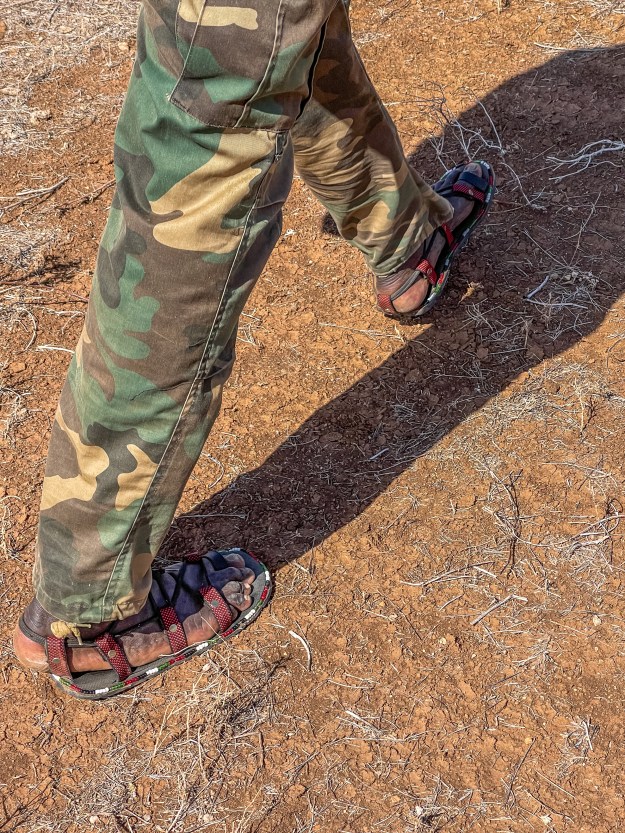
Tioko showed up in fancy sandals way too small for his feet.  He must have borrowed someone’s clubbing shoes!

Today we walked 17 miles.

Click to enlarge photos.

A large group of elephants were spotted on the ridge line.  Iain headed in their direction but the wind was blowing our scent towards them so they started to turn in a different direction. We changed course and ran across the plain to meet up with them. This time undetected.  With the Henry Mancini “Baby Elephant Walk” playing in my head, we followed them towards the river. Walking briskly to keep up then running around the saltbushes to watch them at the water. 

It seemed strange in our given environment of not seeing another human or non-wild animal on this journey to walk into a huge herd of cattle and goats shepherded by children appearing to be 6 to 14 years old.  They are from the Orma tribe near the Somalia border.  Supposedly rich Kenyans own the animals. It was fascinating to watch. The kids were bathing and cleaning their clothes in the river.  Their life is dreadfully hard and often short lived.

At lunch time we crossed the Galana to a grove of palms where the crew had set-up a tent and brought lunch while we walked. To relax, cots had been placed under the palm trees. We rested and then headed out again.This time we walked to the finish line!  100 miles in 10 days.

It was an adventure of a lifetime.  The crew at Tropical Ice has this down to a science.  We were so lucky that the three additional walkers were fantastic, lovely people.  A couple from Colorado and a 84 year old retired doctor from San Francisco.  We giggled so much.

We’re two very grateful people.

The Great Walk of Africa Day 9

What you don’t know won’t kill ya. Apparently that’s not the way in the bush. 

This morning I felt like Emily Blunt in the The Quiet Place movie.  The predators are out there….  There’s no Jaws movie music Da dant da dant da dant.  Not only have we taken the oath of silence so have the predators.  It’s a quiet killing grounds in Tsavo. The only things making noise are the harmless birds.  HA!!! The stuff I think about…..

Lots of game sightings today – zebras – elephants – gazelles…

Click to enlarge photos…

It was a peaceful day with no heart pumping events.

Until we were about to cross the Galana River back to camp. Toiko and Washii started into the water when a crocodile’s tail took a swing at their ankles. Both jumped back to the shore quicker than a Kenyan runner. Toiko minus a sandal. He returned to camp shoeless. Poor guy.  It will be a long time before the guys stop teasing him about this one.

The surface beneath our feet is a bit of a conundrum – harsh, dry, and barren like the surface of the moon and closer to the shore there’s beautiful fine white sand. There are a few springs of greenery sprouting.  Otherwise, food seems either non-existent or inedible.  How any animal forages and lives in this area is baffling

Look who tried to wander into camp. Yes. That’s Bill at our tent.

Hello Bill – do you see the elephant?

On our evening game drive we drove up to a male and female pair lounging in the sun.  Jokes about the manly lion ensued… To prove his virility the male jumped on the female. Big her in the shoulder and did his thing. Who’s king of the jungle now?

Tomorrow is our last day of walking and it will be a full day. We leave at our usual 7 am departure time and will not be returning until 6 pm…..

The Great Walk of Africa Day 8

Once again we woke up thinking it was raining and it was a baboon in the palm.

Eight graceful giraffes passed by early in the morning. They generally can be seen with zebras grazing about.  If you look closely in the photos you can see that the top of a zebra is as tall as the under belly of a giraffe.

Our day started with a river crossing.  After the last hippo “stare down” this one went off without a hitch. We cross and on the shoreline stop to change our shoes. Usually the bank is an incline, and after a scramble, we are up on the plain. Upon cresting there was a hippo off to our right side several yards away. Immediately Iain and the men lined up and were at the ready with guns drawn. We were told to run.  ‘Stay together and RUN”.  The hippo had turned and looked like it might charge.

By the grace of God he changed his mind. Hippos are mean and fast. Iain said “They tend to get discombobulated and either run away or charge.”

Another thrilling event. I think I have said “Holy shit” about 10,000 times on this walk!

In all the years that Iain has led these safaris they have only had one serious incident where a hippo charged and knocked over a ranger and then picked up a woman client and flung her.  They weren’t unable to shoot it with the woman in its jaws.  It was in 1987, In the middle of nowhere and no way to communicate. It took them five hours from the time of the incident to the moment she got to a hospital.  She survived with a long recovery period.

With this crisis averted we began to walk again….

Approximately half an hour later Stephen spotted a female elephant in the saltbrush several yards away. A few days in the bush and he’s a tracker!  Lajori did his soft whistle to let Iain know. Normally we can pass undetected.  This elephant stepped out of the brush and made her presence known. She knew we were there.

Once again Iain shouted “RUN and keep running.”  Lajori directed us with a rapid wave.

Iain fired a warning shot into the air. The elephant hesitated and then started to charge.  Toiko then fired another warning shot.  All the while Washii is making a repetitive rhythmic sound from the bottom of his throat – as if he was trying to calm the elephant. 

She finally decided to turn.

Heart racing…. What now? Lions???

It was quite a morning – 10 mammal sightings and two heart racers in 1.5 hours.

The rest of the walk was uneventful.

The game drive was a lion experience. We first came upon two laying on their sides, out like a light, without a care in the world. Our Rovers drove right up to them and one barely opened his lazy eyes and closing them promptly as if he couldn’t be bothered. The lion beside him didn’t even budge. Moments later a maneless male came out of the saltbush – moseyed along and then fell to his sleepy side. Then another large maned lion came out of the bush.  He majestically sat for a brief moment, looked around and then curled up next to his brothers side.

Kim and I decided to check out the kitchen at the campsite. Kikuyu, camp chef for 40+ years makes meals that one would think came out of a gourmet kitchen. It’s hard to believe that they are made with such basic necessities.  The Dutch oven reminds me of an old metal ammunition box and bakes the bread and rolls to perfection.  Kikuyu uses a shovel to raise the box’s lid.  Here are some camp life photos.

Elephant tracks right in-front of our tent!

The Great Walk of Africa Days 6 and 7


Sunrise happens quickly in these parts. Beyond our jambo wake up call the sun ushers in a yellow and orange medley of colors setting the tent aglow. To our surprise, on the way to the bathroom, the full brilliant moon was setting between the doum palms. Last night the palms were alive with baboons scurrying about shaking the branches and making the sound of a monsoon rain. This morning all is calm and peaceful.

I failed to mention yesterday that we walked down the Tsavo river toward its confluence with the Yati River which together form the emerald green Galana River.  You can see below where the color changes.  We had been using the Tsavo River water for showers but the water from the Galana is not used in camp.

This brings up the big question “Why are we wading through it?”  Yes, this too I failed to mention (on purpose) because I didn’t’ have photos.  We’ve been crossing the river. The body of water full of savage crocodiles. Crocodiles make alligators look like baby lambs.  They are bigger, stronger and look for trouble.  We paid for this!

So here are the rules:  We only cross at elephant crossings – never where there are smooth rocks where you can hopscotch across the river (because the crocs lurk there). We are to look BIG.  To do this we grab our partner’s hand standing shoulder to shoulder and then we hang onto the person in front of us – bellies to butts. No talking and walk briskly!

Lajori and Tioko test the water before we start.  They throw rocks in and then grab poles and stir the water.  The water depth is unknown but perceived to be okay.  The short women get an occasional douche and the guys mostly get the bottoms of their shorts wet.  I walk on tippy toes.  If we can’t bathe with this water I certainly did want it going where it doesn’t belong.  I have enough things to worry about.

Day six we walked a new trail for this safari.  Not only are we chum but now guinea pigs.  As we prepared to cross the river a crocodile slipped off the shore into the water. Red alert. My heart starts racing.  Iain walks 75  feet down the shore and says this will work!

Day seven our river crossing area was full of luxuriating hippos.  Iain had us walk down the shore and away from the herd but fairly close to a single hippo submerged in the cooling water.  I’m sure he saw the concern in our eyes and promptly exclaimed, ‘If we all huddle together and move quickly we might all make it!”  Some of our crossings are more than 100 yards wide so I’m sure even a hippo could catch us.

I think every one of us stared down that hippo and never even thought about the crocodiles.

From the Yatta escarpment to the Galana River elephants have forged a path for over a thousand years.  For Bill and me, this may be the first thousand year old trail we’ve hiked which was not built by the Romans.

The volume of game grows daily.  Especially the elephants.  Their nature is so human like. Witnessing up close the way they nurture and discipline their babies could keep me spellbound for hours.  A memorable moment was watching a female dig a hole in the sand to find filtered water.  She’d scoop it up and throw it over her shoulder.  In the meantime, her baby, thrilled to drink from the same hole, tried to get on the action only to be continuously pushed aside so mama could finish the task at hand.

Each evening while eating dessert Iain likes to tell us about what to expect the next day. Tonight’s briefing ended with a story about what happened on his previous safari two weeks prior on the same path we will walk tomorrow.

Of late the vehicles wait for us to conclude our walk and we drive back to camp.  Simon, the other driver, had gone to the pick-up site early.  As he waited for Iain and his group to crest a hill before crossing the river he witnessed a lion stalk and kill a zebra. Right in the pathway where Iain would emerge.  He had no way of warning them.  They were off the grid – no cellular service and the emergency radio only worked one way.

Iain said as he and the group were about to crest the hill he came face to face with a bloody mouthed lion.  Both stood there shocked.  Seconds later the lion turned and ran away.  Iain said one of the walkers fell over right there in his tracks.  I’m sure that’s the least of what I would have done.

We were left with this story.  Go to bed, sweet dreams and tomorrow might be real fun……

Photos from the day. Click to enlarge.

Driving to the starting point:

Walking.

Iain showing off his rock climbing skills.

Game drive.


Walking the Great Walk of Africa Day Five

During the building of the Kenya-Uganda railway in 1898, in nine short months, two man-eating lions killed over 135 workers. Colonel John Henry Patterson, an English military engineer with Indian experience was in charge of the project and building a bridge over the Tsavo River. He killed both lions.  They are known as the Man-Eaters of Tsavo and are now on display, in of all places, the Field Museum of Natural History in Chicago. We hiked to the cave where Patterson said the lions would drag their victims.

click to enlarge photos…

Patterson’s Bridge:

Walking across Tsavo West ✅

Leaving the wetter more mountainous portion of Tsavo West will change the game encounters.  In Tsavo East there will be more lions and heavier concentrations of elephants.

Registering at the new park triggered a memory – the ranger approached the vehicle wearing a freaking face mask. Covid. Something that hadn’t crossed our minds for days. Living in the bush is an option folks!  Fiction is better than reality.  

We had to a short drive down the Nairobi Mombasa Highway, named the most dangerous road in Africa, to start the new portion of the walk. Iain said walking amongst predators was safer than crossing the road.

We walked through an old rail station. Closed in 2012 because the new fast Chinese rail would no longer stop here and 40 other stops along the way. Everything was left behind.  Ticket books still sat on the counter. It was as if time had stopped.

With breezy and often times overcast days and temperatures around the low 80’s walking has been lighter and easier than if the sun blared all day.

Some of us scaled the top of a huge rock embankment at one of he breaks. Check out the view.

A two hour drive got us to our camp.  Our new home for the next three nights.  

Bull elephants are known to hang out and walk through this site. Iain refers to them as the “retirement group”.  Today, at tea time, one such male decided tho walk up to the mess tent.  Thank God Iain had popped his head in only moments before the encounter. He ushered the few of us there into a group and we moved around like frogger trying to avoid a visual face to face with the big guy.  It was quite exciting and not to mention scary.  My heart was racing. 


While driving today Lajori whispers “simba” Swahili for lion.  Only a Samburu bushman with an innate sense of what, I have no idea, could have spotted lions resting in the distance under a bush.  The same bushes we walk by 100,000 times a day! It took me several minutes with Lajori pointing in their direction and binoculars to find them. Iain drove closer for a better look. This man has no fear!  This is only a few hundred meters from our campsite.

Nighttime pees take on a whole new meaning!


Mzima Camp

Good Lord. Oh dark thirty. We had just fallen asleep.

Breakfast at 5:15 am so that we could be ready for our 5:45 start to Tsavo.

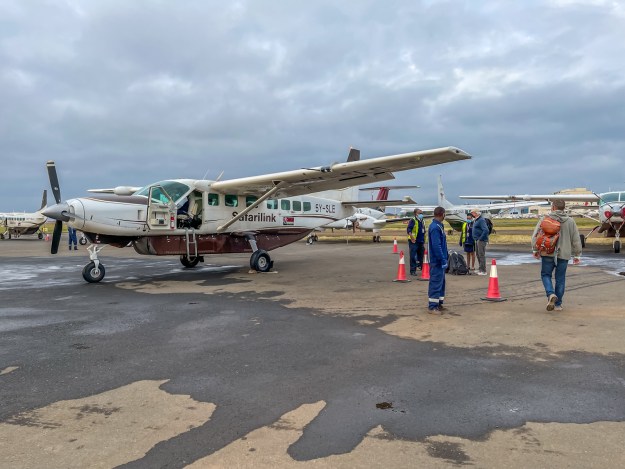
Our flight didn’t leave until 7:30 and the airport was only 15 minutes away. Leaving before gridlock would leave down time but ensure we made the flight.We boarded a 12 seater prop plane. Some of the guys had to crawl to their seats. It was a quick one hour flight to Tsavo West. The welcoming crew was two grazing giraffes just on the side of the dirt runway. The real deal. Not a zoo. Just two giraffes hanging out.

We hopped into a modified Land Rover Defender. Bill and Stephen sat behind the driver. Kim and I loaded up in the next row with Washii, our spotter, sitting on the back roof. Within no time we were standing on the seats with our heads and shoulders peaking out of the roof spotting game.

The rest of the crew loaded up in second Rover and we headed to breakfast at the Kilaguni Serena Safari Lodge 45 minutes away.

Cape buffalo, warthogs and zebras (the Brits say zeb-bra) grazed while we stuffed our bellies.

Two more hours to the first camp – our jaws wide open as more wildlife started to appear.

Click on photos to enlarge.

According to Iain we were very lucky to see a leopard lying next to the road. A rare occurrence since they are nocturnal. Looks like he got in a scruff only hours before.


Meet our fearless leader Iain. Iain started Tropical Ice and the Great Walk of Africa 43 years ago. Born in Scotland and raised in Kenya since the age of six. A lover of the outdoors, modern day Indiana Jones, avid reader, movie buff, John Wayne impersonator, comedian and head man in charge. This will be his 93rd walk.

Yes, we fools paid lots of money to walk 100 miles across Tsavo West and Tsavo East. We’re the chum to the predator’s delight. No pussies allowed.

The safari of my dreams has been altered.

Yes, we have tents, twin beds and even woven rugs. It’s a throw back to safari’s from the golden years. Everything we need and then some. Bathtub and chandeliers are foolish childhood dreams. This is a big girl’s camp.  It’s like drinking black coffee.

There is a mess tent where we are served three outrageous meals a day with tea and crumpets each afternoon. It’s perfect. The only downside is we are in Tsavo which means “Place of Slaughter”. Predator’s stomping grounds…. Going to the bathroom in the middle of the night is scary!!!

This camp is named Mzima (alive in Swahili). That’s because it’s the start of the journey and at this point we’re all still alive.

Time to relax and settle in. The walk starts tomorrow.

Karen, Kenya

Adiós Hilton we’re heading to Karen.

The drive out of the bustling city of Nairobi pumped new blood into our systems. The Hilton was so depressing that the excitement of the actual movement of the car felt like we were experiencing our first flight on the Concorde.

The outskirts of the city reminded me of La Paz, Mexico where tall buildings turned in to short ones and outdoor markets sprung up like weeds in the desert selling everything from nursery plants/pots to bedroom furniture and homemade BBQ’s. The difference here was the speed at which the cars moved and no place to park and shop.

Markets became stone houses behind tall fences and concrete sidewalks became lush country lanes. Grass and flowering bougainvillea abutted the roads – clean air once again.

I couldn’t help humming – country roads take me home to a place I belong – the West Virginia part part didn’t quite fit but you get my drift.

First stop. The Karen Blixen Museum which is actually her second Kenyan home. If you haven’t seen Out of Africa I highly recommend it. Produced in 1985 it starred Meryl Streep and Robert Redford.

Ms. Blixen’s namesake and 6,000 acre farm, wood lands and coffee plantation occupied the land where the suburb of Nairobi now stands.

Click on photos to enlarge.

Next stop the Giraffe Center in Langata. It started in 1979 as a place to preserve the Rothschild Giraffe. Now it educates thousands of Kenyan school children every year and tickles the fancy of giraffe loving tourists.

It’s like feeding ducks in the park on steroids. Most entertaining was watching giggling adults act like unabashed children. Reaching skywards towards these towering gentle giants with their fingered food pellet saying to themselves “Pick me, pick me, pick me.” Giddy when a bristly, long, pointy tongue lowers to greet their fingers. Slurping. Leaving a trail of spit like a spider’s web. A sign of treat well received.

Our final stop before our 5 pm meet and greet with our safari tour was the Kazuri (small and beautiful in Swahili) Bead Center. Founded in 1975 by two single moms. They grew a work-force (pre-Covid) to 340 mostly single women chosen out of the slums. These ladies were taught how to make clay by scratch, fabricating pottery and beads for jewelry. Sadly, now only 60 women are employed and shops were closed due to lack of funds to pay the rent. Normally the tour is closed on Sundays and only the store is open. Luckily Kim and I were given a private tour where we learned about each step in the process from earth to end product.

The four of us checked into our stunning suites at the Hemingways Hotel and promptly met our guide Iain along with three other brave Americans (coincidentally) that we would be joining on our safari.

I had dreamed about an Africa safari for years. A luxurious tent with chandeliers, rugs, fluffy bed and a bathtub where giraffes would stroll up to the side and drink from the bath water while I lounged in bubbles sipping champagne……

After an hour of introductions and getting the low down on our journey out of Karen the following day – we departed with a reminder to be in the lobby at 5:45am.

A leisurely (Kenyan way) al-fresco dinner gave us barely enough time for a quick bath before bed.

Not much time to enjoy our Suite.

Such is life…

El Salvador

By now you most likely know this but I’ll start with a quick update on the fallout from the presidential election in Bolivia.

Striking and riots continued after our notorious night time escape a few weeks ago.

On Saturday the police stood in unison with the people of Bolivia. After, Morales, the president said he was up for another election. Sunday morning the military stood with the people of Bolivia. By Sunday afternoon the military and police suggested Morales step down and he did – running to Mexico for safety. Now what?Onwards….

We flew from Managua, Nicaragua to San Salvador, El Salvador. Unfortunately it’s known as the most dangerous country in Central America due to crime.

I say it’s the most dangerous because there are 6 active volcanoes (17 inactive) and earthquakes are commonplace. Witnessed by us as our hotel swayed in the 5.1 quake on day two, the aftershock that shook the pool deck and the 5.9 quake the next day that lasted longer than the day before. Yieks!!!El Salvador has suffered severely. The civil war was from 1980 to 1992 and it’s only now slowly turning around. A new president was elected in June and citizens seem happy. Gang violence, drug trafficking and crime is the current battle.

Despite the negative, this place has me bewitched. The people couldn’t be nicer and it’s absolutely beautiful. We toured the city center of San Salvador (Sivar) where the El Centro market expands 20 blocks. Everything from undies to Christmas decorations can be found here.

The Cathedral – rebuilt for a third time in 2001 – a victim of multiple earthquakes. Hopefully someone got a clue this time around and built it to earthquake standards.The fascinating pressed metal Basilica Sagrado Corazon Church had multi cultural beginnings. Around 1901 some of the 14 rich families that once financially ruled El Salvador decided that since they were doing so much exporting of goods they needed to import items as well. Case in point – “Let’s order us up a church and hospital. We’ll have Belgium manufacture the pressed metal walls. Indonesia can make the wooden supports. Italy can supply the tile floors and let’s get the windows from Spain.” I’m sure it went something like that…..

It was erected first in Belgium (to make sure all the parts fit), dismantled and then put on multiple ships for delivery. The church parts made it to San Salvador but one of the ships carrying parts for the hospital accidentally delivered them to San Salvador, Brazil. Whoops!

Completed in 1913; the metal walls looks like an exquisitely designed stone building and the ceiling looks like the hull of a ship.Your word is a lamp for my feet, a light on my path. Psalm 119:105. Welcome the El Rosario Church. Inconspicuous on the outside, this concrete building is filled with God’s light on the inside. Free of structural pillars – this beauty literally shines.Off to the countryside where jungle greenery surrounds hilly roads. We headed to the small colonial town of Panchimalco. A stop in Planes de Rendero for pupusas, gave us expansive views and a glimpse of Lago de Coatepeque.My favorite place was the adorable town of Suchitoto on the Ruta Azul in the state of Cuscatlan.There we stopped at:

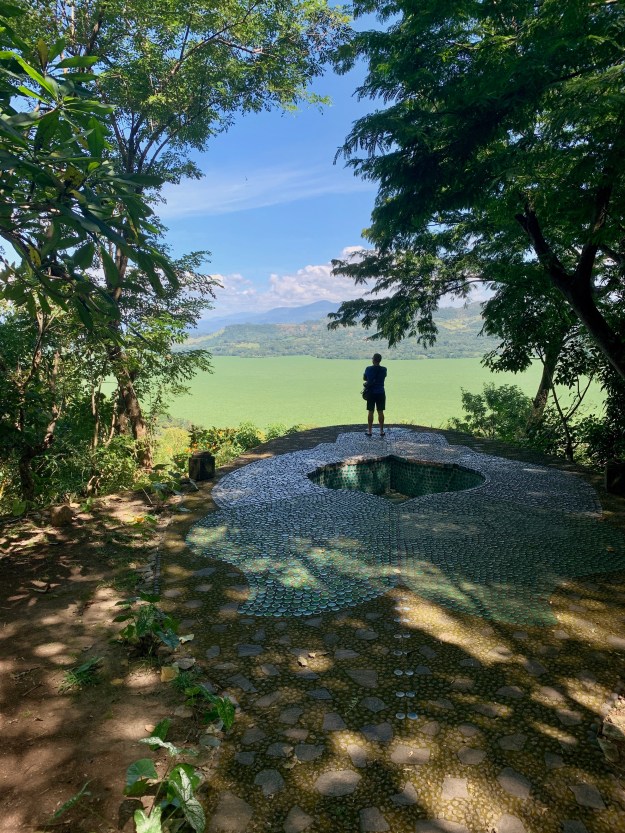
Film maker Alejandro Cotto‘s hacienda which he donated to the community after his death.And – Casa 1800 for views of Suchitlán Lake which is currently covered in a bed of lilies (an annual event). The limonadas were delicious.Suchitoto was so captivating. Tranquilo with colorful, terra-cotta roofed homes and cobblestone streets. Lavish, lush, with dense vistas, charm and preserved structures make this a popular destination.One wouldn’t know this peaceful community was a hot spot in the war where the people suffered the worst atrocities.Trans-Americas Journey’s blog discusses Suchitoto and the war – click here to read.

Women have been greatly persecuted here and solidarity stamps supporting women’s rights are found on walls outside of homes saying women will no longer be victimized.Next time we’re staying here, overnight, to linger.

Oh yeah and cruise the Ruta de Las Flores.It’s Christmas in El Salvador.

We normally don’t do this but with all the negative press about El Salvador we hired EC Tours to drive us around and teach us about their country. They’re the best and we highly recommended them.

Some fun little tidbits:

We’re used to being called gringos in Mexico but in El Salvador’s we are Chelitos. White skinned.

A cora is a quarter. When El Salvador adopted the US dollar as their currency the locals had a hard time saying quarter so they said cora.

Chivo means goat. However they say – Que chivo for how cool.

We saw a Ferris Wheel in the distance and when we pointed to it and said “Hey, there’s a Ferris Wheel.” Our guide Estefany said “That’s a Chicago.” So for those of you who don’t know the Ferris Wheel was built for the World’s Fair in Chicago.

Life is good!!!

Panama City, Panama

Believe it or not immigration in Panama did not ask about our flight out of Panama. Go figure.

The airline clerks in Lima were more about Panamanian Immigration than the Panamanians were.

It’s all smoke and mirrors!

The good thing about the whole ordeal was that we didn’t have to spend the night in the Panama Immigration Hotel.

The first day was the hop on hop off bus and Yup…. it was a national holiday – diá de bandera (flag day) and half of the bus stops were closed. One being access to the historic district – Casco Viejo and all the museums. Flag day in Panama is a big deal. We caught a glimpse from the bus and hundreds of thousands of people were out packed in like sardines celebrating. It was great fun to see.Lucky for us we got to watch a huge ship go through the Miraflores Locks at the Panama Canal. I was able to experience locks growing up on Saranac Lake in New York. It’s a tedious and meticulously planned operation. Train-like engines guide the ships through the canal keeping the boat in the middle. It was a bit like watching water boil but thrilling none the less.

A malecón (seaside walkway) called Cinta Costera Park links the wildly growing modern urban center to Casco Viejo – Panama City’s spectacular old town and UNESCO World Heritage site.We baked ourselves in the sun walking from our hotel to the historic center on the Cinta Costera but enjoyed the seaside breeze in the evening on the way back. Skaters, walkers, joggers, dancers, vendors, kids and their parents, novias and amigos relished in the cooler night temperature.
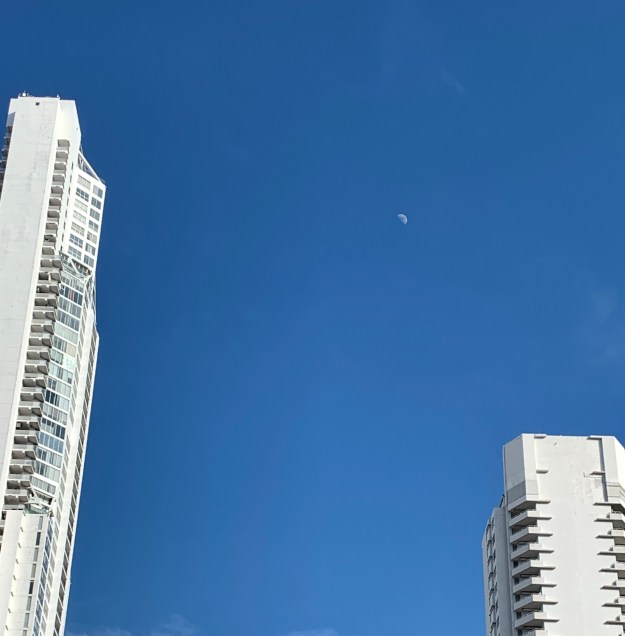
Casco Viejo is a mixture of crumbling abandoned buildings and new or newly refurbished ones – stately, ornate and adorned with Spanish inspired balconies. Fantastic restaurants, super cool hotels and fun bars.Oh yeah – the moon righted its self. Explain that to me please!We happened upon a runner, Jan-Casper Look, who just completed running from Vancouver, Canada to Panama City. Phase one of his journey. It took him a year. He runs pulling a cart behind himself averaging 30 miles per day. You can follow him on Instagram @jclloo21 where there’s also a link to his blog. And we thought walking a few Caminos was a big deal.
Strange and crazy. This Camino Pilgrimage symbol was on a building in Casco Viejo!

The Peruvian Amazon

I sit on the top deck of our river boat typing and glimpse the pink dolphins frocking in the muddy water as white birds dance in the sky. Rising and falling to the sounds of nature. It’s a sight to behold.A two hour flight from the coastal region of Lima had us flying over the Andes mountains and landing in the jungle, Iquitos.Iquitos is the largest city in the world not accessible by road.

Our boat awaited one and a half hours away. The bus ride ended in Nauta where we boarded the Amazon’s only wooden river boat, the Amatista, for a seven day cruise.Before the road was paved in 2005 the journey from Iquitos to Nauta took 12 hours.15 Germans, 4 Canadians and 5 Americans filled 13 of the 15 cabins.

The Amazon’s wet season officially begins in November.

Clear skies on the first evening showed stars so abundant they seemed to be growing out of the tree tops. The Milky Way floated above our heads and the moon looked like it slipped – a U shaped sliver instead of a C shape.The abundance of flora and fauna was staggering.

Here’s a partial list of what we’ve seen: pink dolphins, manatees, a kinkajou, a coatimundi, butterflies, an ajouti, pigmy marmoset, bats, a black caiman, monkeys, frogs of all colors, a red tail boa, an anaconda, 3 sloths, birds too numerous to count, piglets (special Amazonian variety – HA), a tarantula, gray dolphins, turtles, household pets, ducks, chickens, roosters, piranhas and gazillions of unwanted bugs/mosquitos.

Every day we took two skiff boat trips – one before lunch and the other later in the day. The naturalists pointed out wildlife while cruising through either muddy brown waters or sleek black water tributaries. Jungle walks gave us the opportunity to get up close and personal with nature and it’s critters.
We visted the small community of Pampacaño – 192 people strong and not in possession of clean water.

A pipe pulls their drinking water from the dirty Amazon. To make it safe as possible to drink the captured water stands for several days so that the contaminates can settle and then they use the water from the top. Oil and lead are amongst the carcinogens.

That day lunch was served from the floor in Maria’s home – we ate with our fingers. One of the items on the menu was paca – a huge two foot rat that lives in the jungle. There too we saw the 15 foot anaconda that crept into their village five days prior.

Amazonians are so used to the rain that they go about their daily routines immune to the drops continuing on as if the sun was shining.

Chicken and catfish are the main sources of meat in the Amazon. Fish and chicken farms are abundant. In the villages people also fish out of their lagoons instead of the unhealthy river.

However, we did go piranha fishing in the black water and dined on them for dinner. Fishing for those infamous people-eating machines (lore) with tiny vicious teeth is quite basic. Take a four foot stick with fishing line tied to one end, a hook on the other and a little bit of beef for bait. You splash the water with the end of the pole and wait to set the hook. Bill successfully caught one flinging it with excitement right on the bag in front of me! They were served deep fried – had a tiny amount of meat, lots of bones and tasted like the grease they were cooked in.
We visited a shaman/midwife. This calm woman all of five feet tall with hair past her bottom and bare footed, studied deep in the jungle for eight years to learn how to use plants to heal. Part of her spiritual therapy is using the hallucinogenic ayahuasca plant. Nine villages are dependent on her to cure aliments and deliver babies.Our crew was the best. The two naturalists were informative and have worked on the boat since it’s inception 23 years ago. The chef could make pollo and pescado in so many different ways you barely knew you were eating it twice a day.It only rained for a short period of time on a couple of days.

Soon it will be raining everyday and the Amazon will swallow the shores – rising as much as forty feet by the end of the rainy season. Homes on stilts will become islands and life goes on.Look at the waterline on the trees!

More iPhone shots: